
Temporary Wars, Permanent Taxes
· 13 min read · Book of Man
The Civil War income tax truly expired. The Sixteenth Amendment did not. How emergency finance, Form 1040, and paycheck withholding built a permanent machine — and how Americans can end it.
Americans often say the federal income tax was supposed to be temporary. That sentence is half memory and half myth. The historian’s job is to separate the two without dulling the moral of either.
Here is the accurate claim, stated carefully: the United States did enact income taxes as explicit wartime and emergency devices, and it did let the first national income tax expire. Later wartime rate spikes and collection machinery were sold as sacrifices for victory. What did not happen is equally important: the Sixteenth Amendment of 1913 was not a sunset clause. It was a permanent constitutional power. The tragedy of American fiscal history is not that a temporary tax accidentally stuck. It is that temporary emergencies taught the federal government how to make a permanent tax feel normal — then how to hide it in the paycheck.
That distinction matters if you want to end the income tax. Strategy built on a false story collapses under the first serious opponent. Strategy built on the real record can still win — but it has to be honest about Constitution, politics, and spending.
What the Founders built instead
The original Constitution did not forbid all taxes on income in the abstract. It constrained how the federal government could raise money. Indirect taxes (duties, imposts, excises) had to be uniform throughout the United States. “Direct taxes” had to be apportioned among the states by population (Article I, Sections 2 and 9). For most of the nineteenth century, Washington lived primarily on customs duties and, later, selective excises — not on an annual inquisition into every household’s wages.
That design was not romantic innocence. It was a political technology: make federal revenue visible at the port and the distillery, hard to expand silently, and difficult to aim surgically at unpopular persons without a fight in Congress. An unapportioned tax on incomes from property would later be treated by the Supreme Court as a “direct tax,” which is why the Sixteenth Amendment was eventually written.
The Civil War income tax: temporary in fact

The first national income tax arrived as war finance. On August 5, 1861, Congress enacted a tax on incomes as part of Civil War revenue legislation; the Revenue Act of 1862 (July 1, 1862) rebuilt the system with the Office of the Commissioner of Internal Revenue — the institutional ancestor of today’s IRS — and a workable progressive income levy alongside broad excises.1
Rates and brackets moved during the war, but the political theory was emergency finance. After Appomattox, the “emergency” taxes became politically vulnerable. Critics attacked the income tax as unfair in theory and inquisitorial in administration — an “army of officials,” in the language of the period.2 Congress reduced and then ended the Civil War income tax; the National Archives and standard tax histories date the repeal/expiration to 1872 under the Grant-era dismantling of most wartime internal taxes (with notable excises such as whiskey remaining).3
So when Americans say “the income tax was temporary,” they are remembering something real — but they are remembering 1861–1872, not 1913. The first national income tax was temporary because Congress killed it. That is the precedent worth teaching your sons: emergency taxes can end when a people insist they end.
1894 and Pollock: the Court blocks a peacetime revival
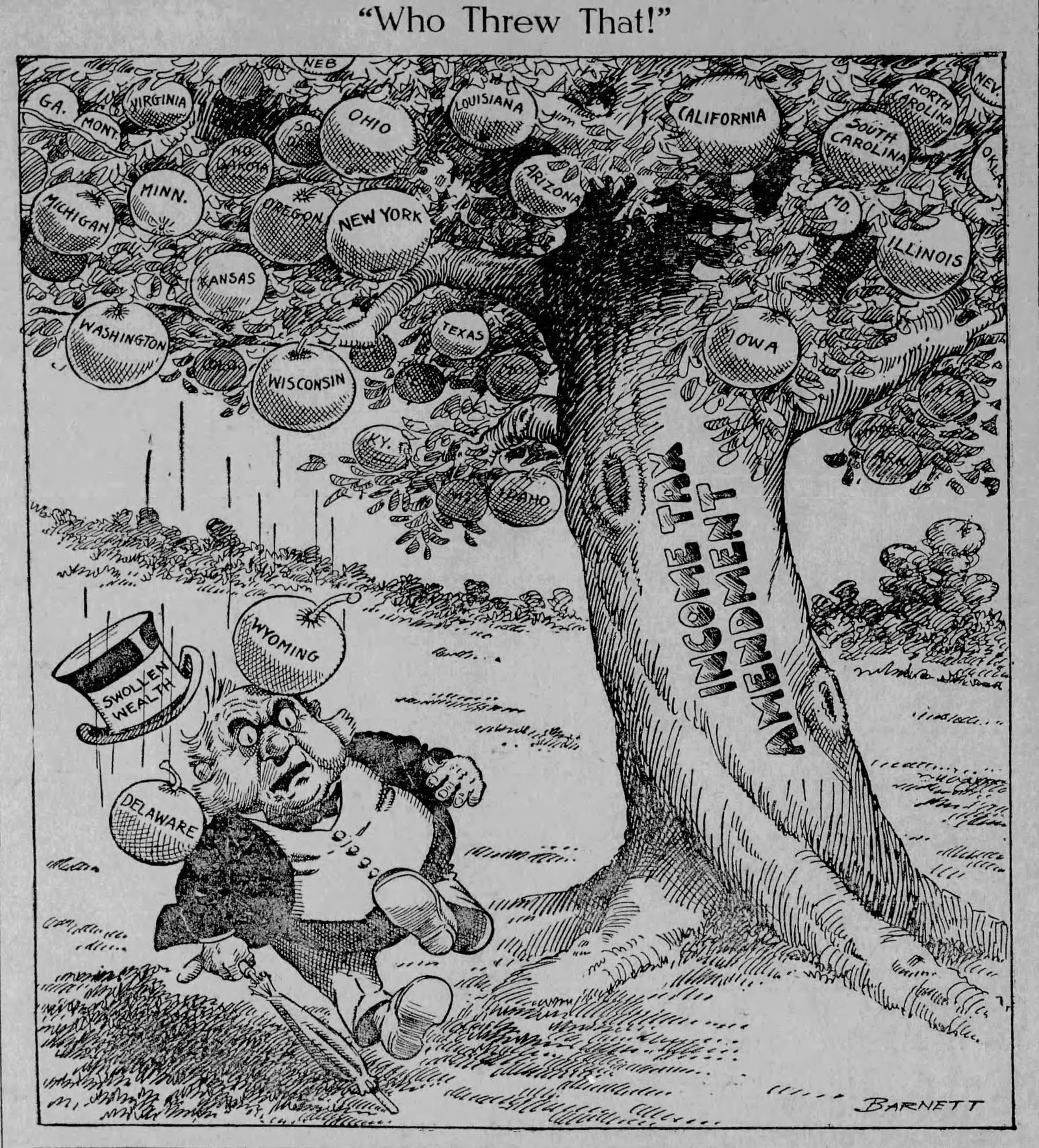
Populists and reformers revived the idea in the 1890s. The Wilson–Gorman Tariff Act of 1894 included a 2 percent tax on incomes above $4,000. In Pollock v. Farmers’ Loan & Trust Co. (1895), the Supreme Court held that taxes on income from property were direct taxes requiring apportionment, and struck down the statute’s income-tax provisions as structured.4
Whatever one thinks of Pollock as constitutional craftsmanship, its political effect was clear: a peacetime federal income tax on the 1894 model was blocked until the Constitution itself was changed.
1913: permanent power, modest debut — not a sunset
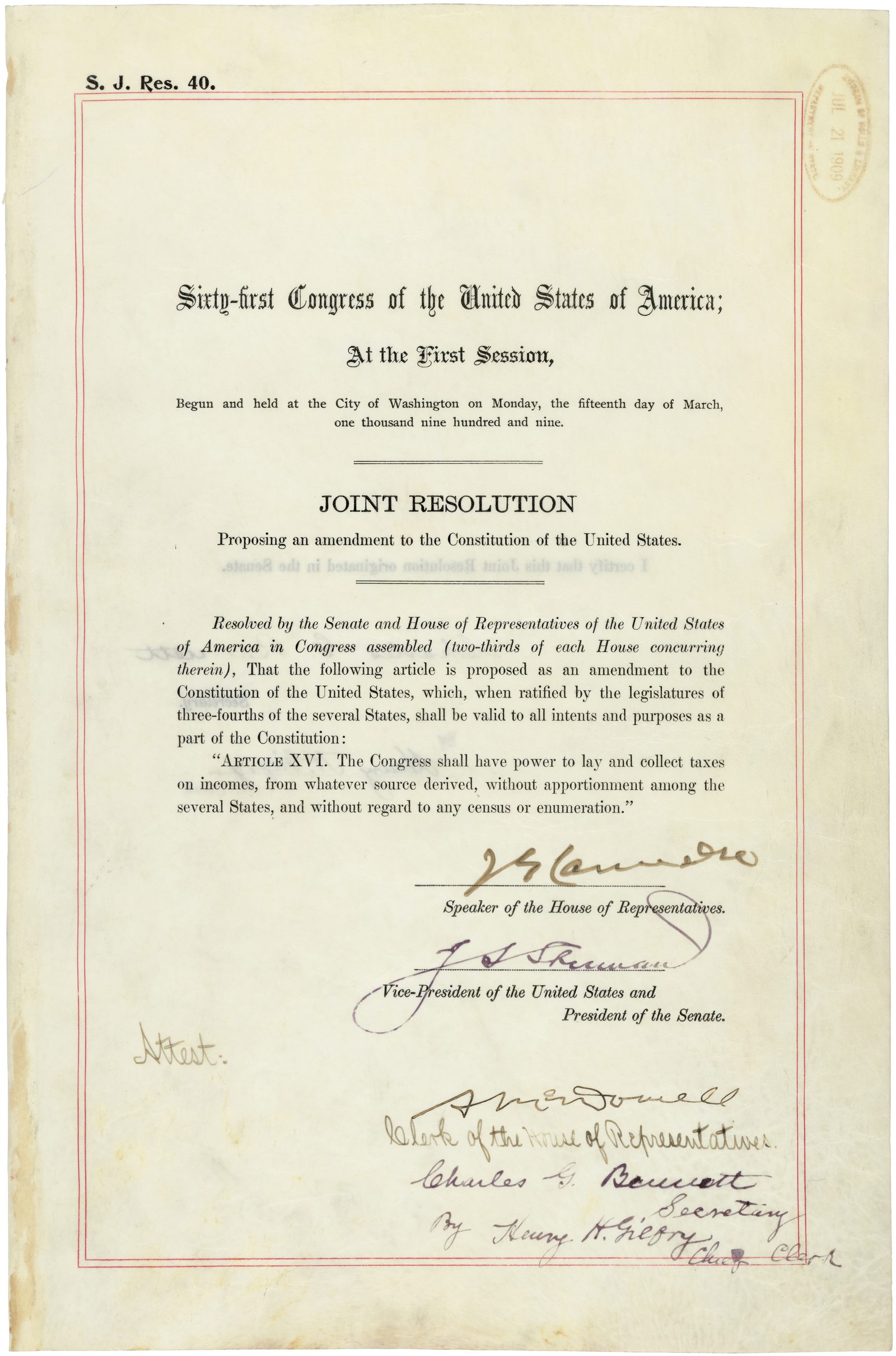
Congress proposed the Sixteenth Amendment in 1909. It was ratified in early 1913 (Delaware’s ratification on February 3 is conventionally cited; Secretary of State Philander C. Knox certified the amendment later that February).5 The text is short and absolute:
The Congress shall have power to lay and collect taxes on incomes, from whatever source derived, without apportionment among the several States, and without regard to any census or enumeration.
Read it as a professor, not as a meme. That sentence creates an open-ended fiscal power. It does not say “for the duration of the war,” “for ten years,” or “until tariffs are reformed.” Popular talk of a “temporary 1913 tax” confuses three different things: (1) the Civil War tax that truly expired; (2) the rhetorical promise that the new peacetime tax would be narrow and light; and (3) later wartime rate spikes that were framed as temporary sacrifices.
Wilson’s first major fiscal statute, the Revenue Act of 1913 (Underwood–Simmons), cut tariff rates and re-established a federal income tax under the new amendment. The initial individual tax was deliberately narrow: a 1 percent “normal” tax above a high exemption ($3,000 for single filers; $4,000 for married persons), with graduated surtaxes that produced a top combined rate of 7 percent on the highest incomes. Contemporary and later accounts agree that only a small fraction of Americans — on the order of a few percent or less — owed the tax in the earliest years.6
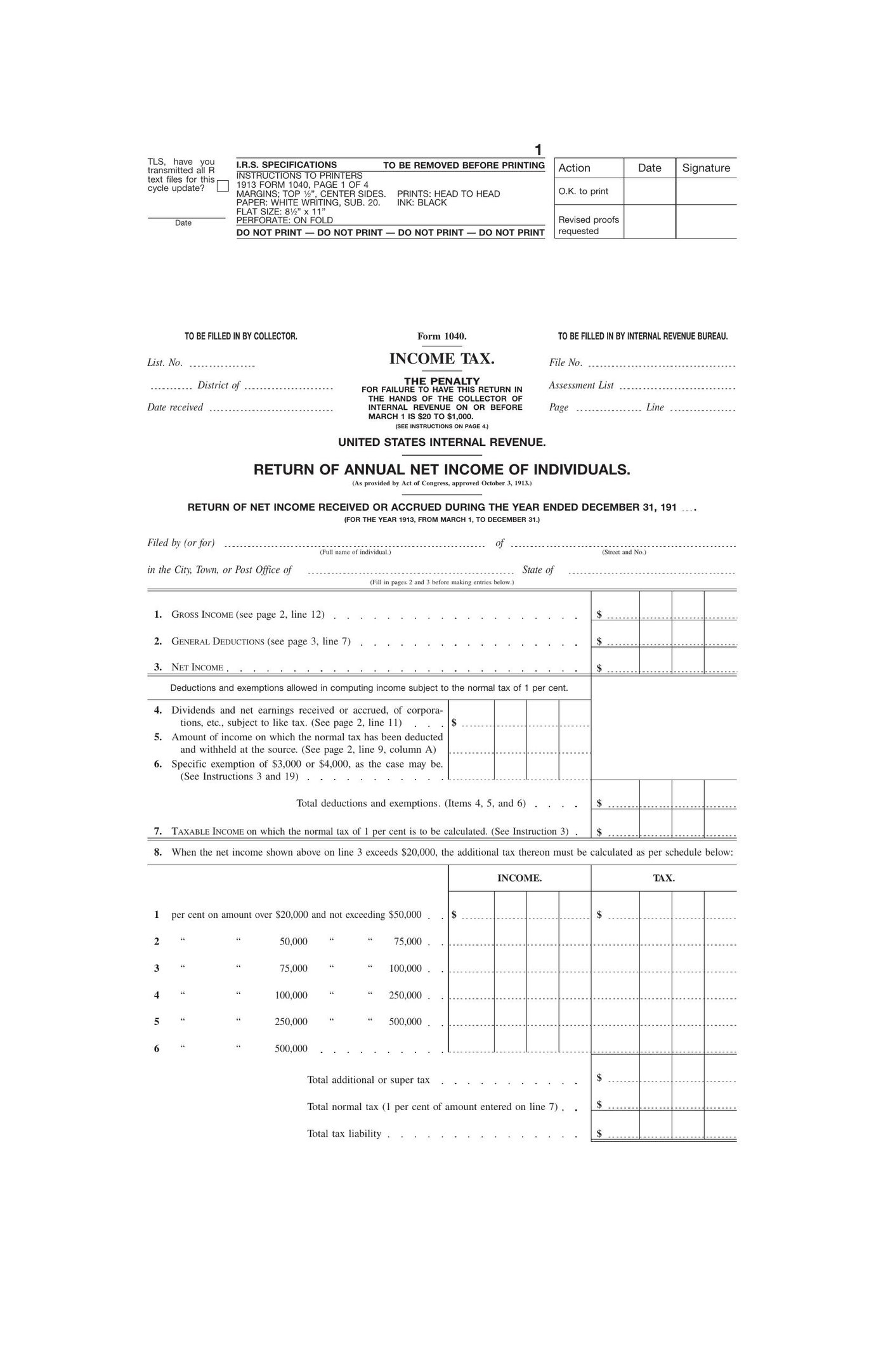
So was the 1913 tax “temporary”? Not in constitutional form. Was it sold as limited? Yes — limited in coverage, limited in rate, framed as a replacement for “unfair” tariff burdens and a tax on the comfortable. That sales pitch is part of the historical record. Treating the Amendment itself as a sunset bill is not.
Wartime rates: the ratchet
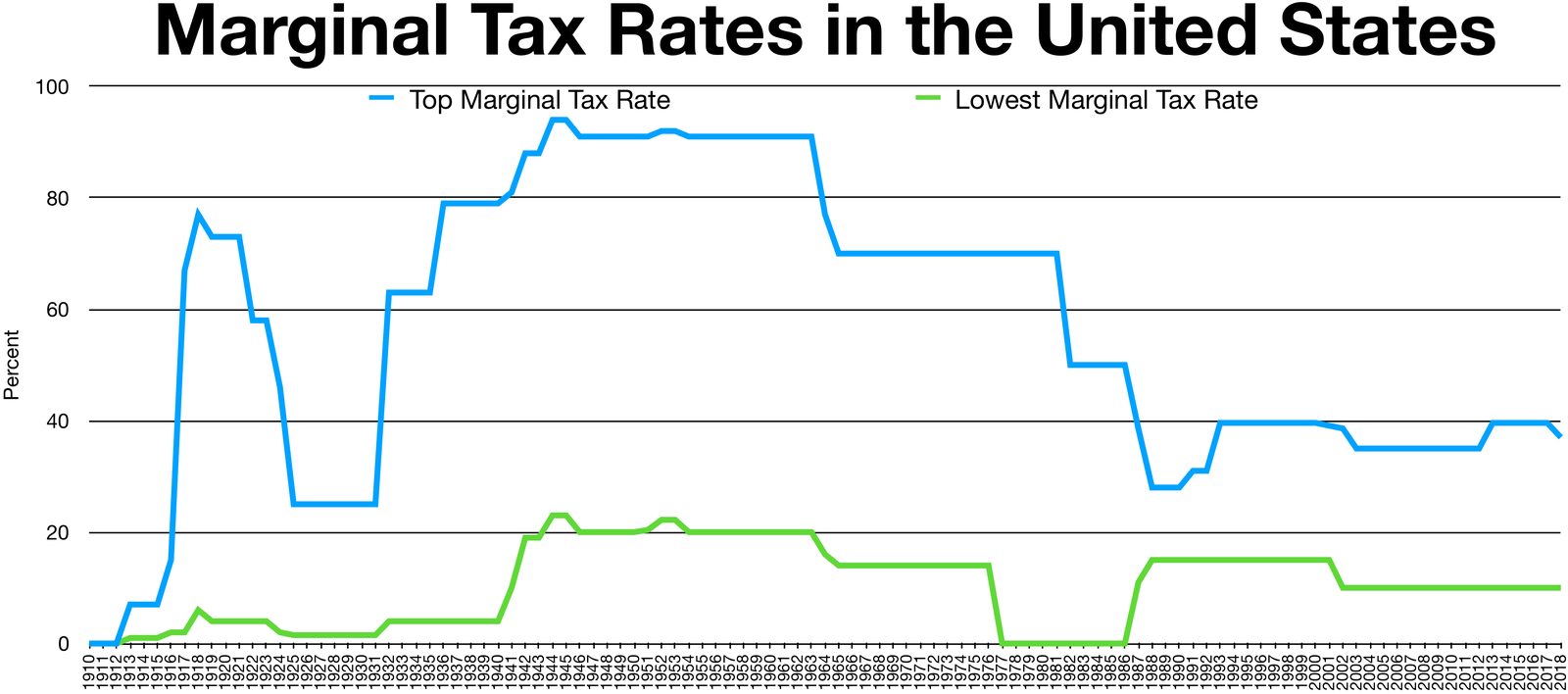
World War I converted a rich man’s tax into a war engine. Top marginal rates vaulted into the 60s and then to 77 percent by 1918 before partially retreating in the 1920s.7 The pattern is familiar to fiscal historians: crisis justifies height; peace never fully restores the pre-crisis floor; the next crisis starts from a higher plateau.
The New Deal and World War II completed the transformation from class tax to mass tax. By the early 1940s, exemptions fell, brackets multiplied, and ordinary wage earners entered the system in large numbers. The Revenue Act of 1942 included the Victory Tax — a flat wartime levy on wages and salaries above a modest exemption, with collection at the source — later reduced and then eliminated by subsequent wartime legislation (the Individual Income Tax Act of 1944 ended the Victory Tax as such).8 The episode matters less as a curiosity than as a method: temporary named taxes train the public for permanent unnamed ones.
1943: withholding makes the tax invisible
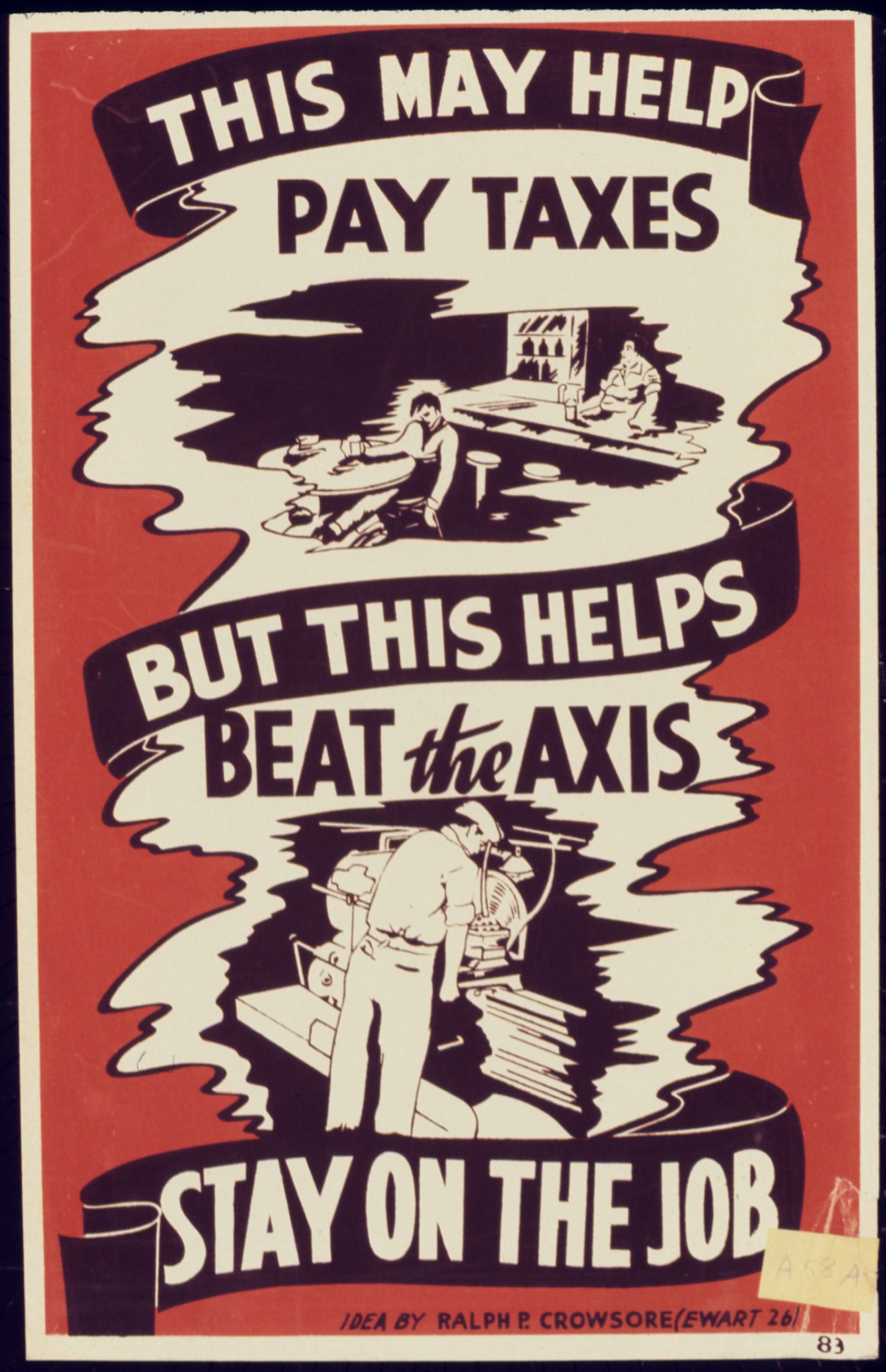
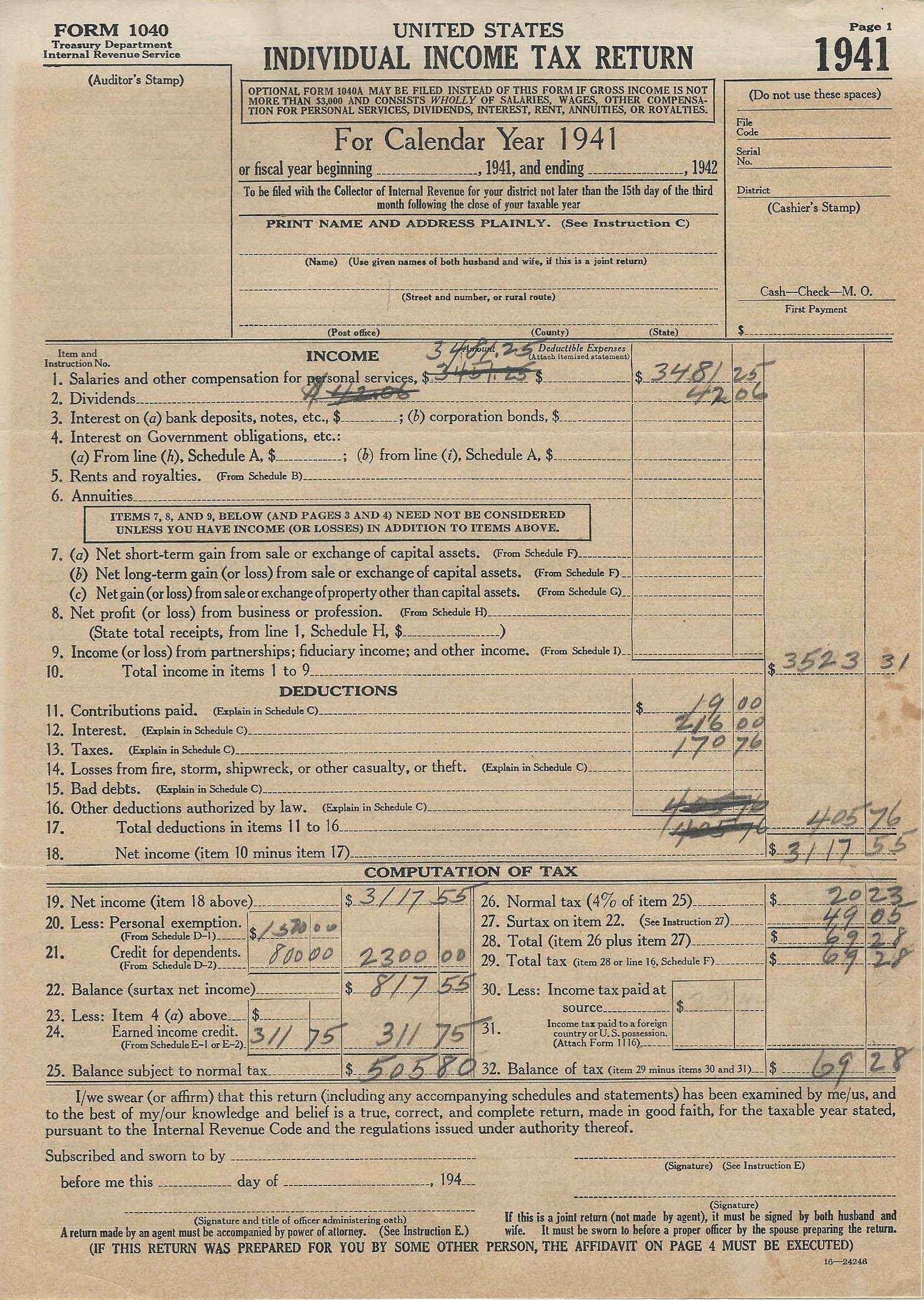
The hinge of modern American tax politics is not only the rate schedule. It is collection. The Current Tax Payment Act of 1943 established comprehensive pay-as-you-go withholding on wages and salaries, moving millions of new taxpayers onto current payment and canceling a large share of one year’s overlapping liability as the system shifted bases.9 Beardsley Ruml’s public campaign for “pay-as-you-go” made the transition politically digestible; Treasury’s long interest in current collection made it administratively durable.
Withholding is brilliant statecraft. Money never reaches the household, so the tax feels like weather rather than a bill. April becomes a refund festival instead of a reckoning. A people who never feel the full debit will not easily repeal the debiting machine.
If you are looking for the moment when “temporary war finance” became the operating system of peacetime government, start in 1942–1943: mass liability plus paycheck extraction. The Victory Tax could be renamed or retired. The habit of taking income at the source remained.
What temporary really meant — and why it still matters
Summarize the record without romance:
- 1861–1872: national income tax as Civil War finance; repealed/expired — temporary in law.
- 1894–1895: peacetime revival struck down in Pollock.
- 1909–1913: Sixteenth Amendment creates permanent unapportioned income-tax power.
- 1913: narrow, low-rate tax on few households — temporary in social experience, not in constitutional text.
- 1917–1918 / 1941–1945: wartime rate and base explosions framed as emergency sacrifice.
- 1943–present: withholding makes mass income taxation administratively permanent and psychologically soft.
The folk saying is therefore wrong as a claim about the Sixteenth Amendment and right as a claim about American political psychology: we tolerate confiscation when it is labeled emergency, then keep the machinery when the emergency ends.
Why ending the income tax would be good for America’s future
A serious case against the income tax is not a tantrum about April. It is a constitutional and civilizational argument.
1. It rewards political predation. An elastic tax on incomes grows automatically with nominal wages and entrepreneurial success. Congress can spend first and collect later. Tariffs and excises are crude; the income tax is a precision instrument for faction.
2. It invades the household. A free people can accept taxes on imported steel or distilled spirits without teaching every husband and wife to narrate their private books to a bureau. The income tax normalizes surveillance as citizenship.
3. It punishes the productive virtues. Extra hours, extra risk, a second shop, a patent, a farm that finally turns a profit — all become taxable events. A civilization that wants builders should stop fining building.
4. It hides the size of government. Withholding and payroll complexity obscure the true price of the state. Citizens who do not feel cost cannot consent meaningfully to cost.
5. It centralizes power away from local life. An income-tax-funded administrative state outcompetes families, churches, and towns as the default insurer and moral tutor. That is not a side effect. It is a governing logic.
Ending the income tax would not abolish all taxation. It would force the federal government back toward visible, politically costly revenue — and force Americans to confront spending as the real addiction.
Call to action: how ending it is possible
Wishful memes will not repeal a constitutional power. Here is a hard path that could work.
1. Tell the true story
Stop claiming the Sixteenth Amendment was a temporary statute. Teach the Civil War repeal, the Pollock episode, the permanent Amendment, the wartime ratchets, and the 1943 withholding revolution. Truth is recruiting: it survives contact with the New York Times.
2. Pair repeal with replacement — and with spending cuts
A naked repeal without a revenue bridge and a spending cliff is a deficit bomb that opponents will use to kill reform. Serious replacement designs usually combine some mix of:
- broad-based consumption taxation (retail sales / “FairTax”-style proposals), and/or
- tariffs and selective excises closer to the nineteenth-century mix, and/or
- a transitional business tax that is not a personal wage tax,
alongside a statutory and political commitment to cut federal outlays — especially open-ended transfers and administrative growth — so the replacement rate does not become income tax by another name.
Do not pretend this is painless. Pretend honesty instead: every dollar of federal spending is a claim on someone’s work. Ending the income tax means choosing which claims die.
3. Use the constitutional tools that actually exist
- Congressional route: statutes can abolish the individual income tax and withholding tomorrow — if majorities exist — while the Sixteenth Amendment remains latent. Latent power is dangerous; permanent victory prefers repeal or replacement of the Amendment.
- Amendment route: Article V — two-thirds of both houses and three-fourths of the states, or a convention of states for proposing amendments. Hard. Designed to be hard. Worth it for a structural change of this magnitude.
- State pressure: state legislatures can demand a convention for a fiscal amendment (repeal/replace Sixteenth; spending limits; supermajority tax rules). This is slow politics, not a weekend petition.
4. Make withholding the first target of public anger
Even before full repeal, ending or severely restricting wage withholding would re-politicize the income tax. People who write a visible check every quarter become citizens again. Expect ferocious institutional resistance: invisibility is the system’s armor.
5. Build a durable coalition, not a mood
Workers who want take-home pay. Small owners drowned in compliance. Young men trying to form households under bracket creep and payroll layers. Churches and civic groups that understand household sovereignty as a moral good. This coalition must reject conspiracy folklore and speak in statutes, rates, and Article V.
6. Vote and organize like grown men
Primary candidates who will not touch spending. Support representatives who will cosponsor replacement-and-repeal packages, defend them in hearings, and accept short-term media punishment. Serve on party committees. Fund litigation and scholarship that keep the historical record clean. Teach your sons double-entry bookkeeping and constitutional history in the same month.
7. Practice the future at home
Live below your means. Build skills that survive tax regimes. Prefer enterprises and communities that do not depend on federal favor. A people addicted to transfers will not repeal the machine that funds the transfers.
Conclusion
The income tax was temporary when Americans still remembered how to end a war tax. It became permanent when constitutional text, wartime ratchets, and paycheck withholding taught a continent to treat confiscation as background noise.
Ending it is possible. It is not mystical. It is Article I majorities, Article V amendments, replacement taxes that do not hunt households, and spending cuts large enough to make the arithmetic work. It is also cultural: a recovery of the older American intuition that a free man’s labor is not a federal entitlement waiting to be withheld.
The future of America will not be secured by a cleverer Form 1040. It will be secured by a people who can fund a limited government without training every worker to be a ward of the Treasury. Repeal the income tax. Replace it with visible revenue. Cut what cannot be paid without conscripting the paycheck. That is not nostalgia. That is how a republic stays a republic.
Selected sources (verify against originals):
- Revenue Act of 1861 (12 Stat. 292); Revenue Act of 1862 (12 Stat. 432); National Archives overviews of Civil War internal revenue and IRS institutional origins.
- Joseph J. Thorndike, “An Army of Officials: The Civil War Bureau of Internal Revenue,” Tax History Project / Tax Notes (2001).
- National Archives, “Income Tax Records of the Civil War Years” (Prologue, Winter 1986); NARA finding aids on Internal Revenue assessment lists noting expiration of the Civil War income tax in 1872.
- Pollock v. Farmers’ Loan & Trust Co., 157 U.S. 429 (1895), 158 U.S. 601 (1895); Wilson–Gorman Tariff Act of 1894.
- National Archives Milestone Documents: “16th Amendment to the U.S. Constitution: Federal Income Tax (1913)”; Congressional proposal (1909) and ratification/certification chronology.
- Revenue Act of 1913 (Underwood–Simmons), 38 Stat. 114; IRS historical Form 1040 (1913); NBER and standard tax-history summaries of 1913 exemptions ($3,000 / $4,000) and narrow coverage; Brushaber v. Union Pacific R.R. Co., 240 U.S. 1 (1916).
- Tax Foundation, “U.S. Federal Individual Income Tax Rates History” (historical tables underlying the rate chart).
- Revenue Act of 1942 (Victory Tax); Individual Income Tax Act of 1944 (elimination of Victory Tax); secondary summaries in tax-history literature.
- Current Tax Payment Act of 1943, 57 Stat. 126; Tax History Project essays on Beardsley Ruml and pay-as-you-go withholding; Treasury contemporaneous explanations of current collection.
Image credits: U.S. government works and public-domain files via National Archives, IRS historical forms, DPLA, and Wikimedia Commons, as captioned above.
Prefer plain text? Markdown version
← All entries